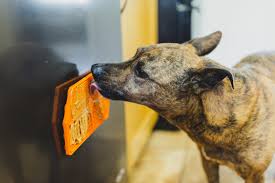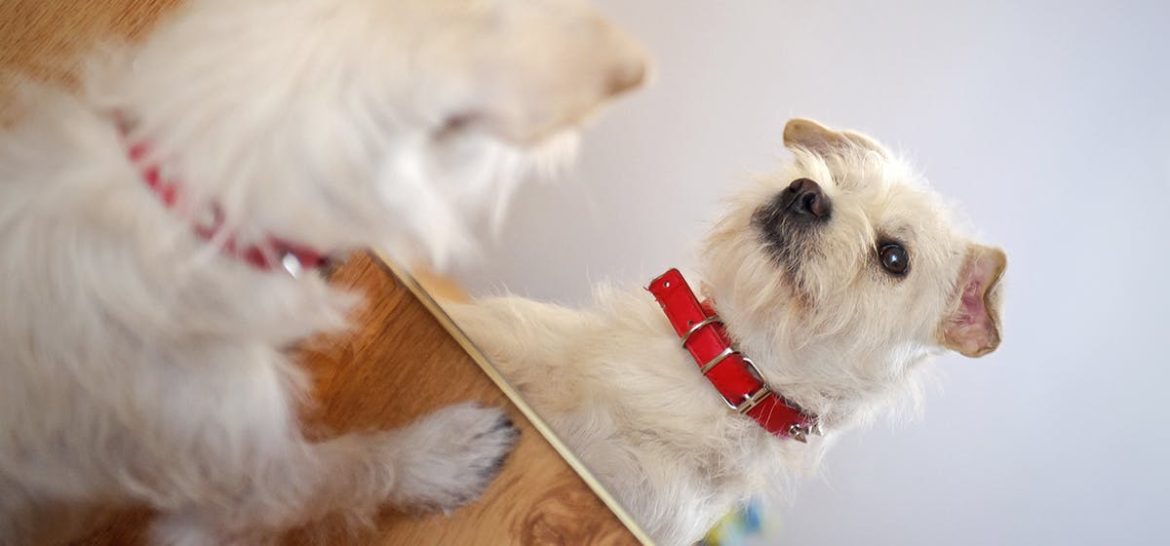
Walk past a mirror with your dog and chances are they will bark, sniff, or simply ignore the glass entirely. Hold a cat up to a reflective surface and watch as they either freeze in confusion or swat curiously at the stranger staring back. These reactions have fascinated pet owners for generations — and scientists have spent decades trying to understand what, exactly, is happening inside an animal’s mind when it confronts its own reflection.
The question of mirror self-recognition goes far deeper than entertainment. At its core, it probes one of the most profound questions in animal cognition: do our pets have a sense of self?
The Mirror Test: What It Is and Why It Matters
In 1970, psychologist Gordon Gallup Jr. developed the now-famous mirror self-recognition (MSR) test. The experiment is elegantly simple. A mark — typically a coloured dot — is placed on an animal’s body in a location it cannot see without a mirror. The animal is then observed in front of a mirror. If it touches or investigates the mark on its own body rather than the reflection, scientists conclude it recognises the image as itself.
Passing this test has become a benchmark for self-awareness in animals. The underlying logic is that to touch the mark on your own body, you must understand that the creature in the mirror is you — not another animal.
Since Gallup’s pioneering work, a relatively short list of species has passed the mirror test: chimpanzees, bonobos, orangutans, gorillas (occasionally), dolphins, orcas, elephants, and — perhaps most surprisingly — European magpies. Humans typically pass the test around 18 months of age.
Read Also: Top Interactive Toys of 2026 — Which Ones Keep Pets Engaged the Longest
What Happens When Dogs See Mirrors
Dogs almost universally fail the classic mirror test. When first shown their reflection, many dogs react as though they have encountered another dog — they may bark, growl, wag their tails, or attempt to play. Over time, most dogs simply lose interest. The reflection does not smell like a dog, does not behave fully like a dog, and eventually becomes background noise.
But does failure at the mirror test mean dogs have no self-awareness? Many researchers argue no. Critics of the test point out that it is profoundly vision-centric, and dogs are fundamentally olfactory animals. Their sense of smell is estimated to be between 10,000 and 100,000 times more powerful than a human’s. Asking a dog to recognise itself visually may be a bit like asking a human to identify themselves by a sound they have never consciously associated with their own body.
Cognitive scientist Alexandra Horowitz explored this idea with what she called a “sniff test of self-recognition.” She presented dogs with canisters containing their own urine, the urine of other dogs, and urine mixed with a novel odour added to their own scent. Dogs spent significantly longer sniffing the modified version of their own scent — suggesting they noticed the change to something familiar, namely themselves. This hints at a form of olfactory self-recognition that the mirror test simply cannot capture.
Cats and the Mirror: Curiosity Without Recognition
Cats have a more complicated relationship with mirrors. Young kittens often treat the reflection as a social partner — hissing, arching their backs, or attempting to play. As they mature, most cats lose interest. They do not, under standard testing conditions, pass the mirror self-recognition test.
However, cats are independent, often indifferent to tasks that do not serve an immediate survival purpose, and notoriously difficult to motivate in experimental settings. Some animal behaviourists suggest that cats may possess more self-awareness than the mirror test reveals — they simply do not have the social motivation to investigate a mark on their own body in the way that primates do.
Interestingly, some cat owners report their pets using mirrors functionally — using a reflective surface to observe something behind them, or monitoring a room through a mirror. Whether this constitutes a deeper understanding of reflections or simply learned behaviour remains debated.
Species That Pass — and What It Tells Us
The animals that pass the mirror test are a thought-provoking group. Chimpanzees, our closest relatives, typically pass after a few days of exposure. Dolphins pass despite having no hands with which to touch their own bodies — they instead position themselves to inspect the marked area directly. Elephants have been observed touching the mark on their foreheads with a raised trunk.
“Self-recognition in the mirror may not be a single ability but a cluster of cognitive capacities that different species have developed in different ways.” — Frans de Waal, primatologist
The magpie result was particularly striking because it challenged the assumption that self-recognition requires a large mammalian brain. Magpies, with their tiny avian brains, demonstrate that the neural architecture for self-awareness may be more diverse than once thought.
Beyond the Mirror: Other Evidence of Pet Self-Awareness
Self-recognition is just one measure of self-awareness. Researchers study a range of behaviours that suggest animals have an inner sense of themselves:
- Body awareness: Dogs and cats regularly demonstrate that they know where their bodies are in space — squeezing through narrow gaps, judging whether they can jump a fence, avoiding objects their body cannot pass through.
- Proprioception: The ability to sense the position of your own limbs requires a basic bodily self-model.
- Metacognition: Some studies suggest dogs show uncertainty about their own knowledge — pausing longer before responding to tasks they find difficult, which implies an awareness of their own mental states.
- Episodic-like memory: Dogs and cats appear capable of remembering specific past experiences, which requires some form of self-centred temporal awareness.
What Other Pets Experience
Beyond dogs and cats, the mirror reactions of common pets vary widely:
- Parrots: Some species, particularly African grey parrots, show intriguing responses to mirrors. While they have not consistently passed the formal MSR test, their complex social and vocal intelligence makes them strong candidates for some form of self-recognition.
- Rabbits: Rabbits often react to mirrors with territorial behaviour, treating the reflection as an intruder. They do not recognise themselves.
- Fish: Remarkably, cleaner wrasse — a small reef fish — recently passed a version of the mirror test, sparking intense scientific debate about what the test actually measures and whether fish can experience self-awareness.
The Philosophical Edge of the Question
The mirror test opens doors to questions that science alone cannot fully answer. What does it mean to recognise yourself? Is there one kind of self-awareness, or many? Can an animal be self-aware in a way that a mirror simply cannot reveal?
Philosopher Thomas Nagel famously asked what it is like to be a bat — arguing that subjective experience may be fundamentally inaccessible to outside observers. The same logic applies to our pets. The inner life of a dog navigating the world by scent, sound, and social bond may be rich with self-awareness of a kind our mirror tests cannot touch.
Conclusion
The mirror on your wall may be useless as a tool for measuring your dog’s inner life, but that does not mean there is nothing there to measure. The science of animal self-awareness is young, nuanced, and full of surprises. As researchers continue to develop more species-appropriate tests of cognition, our understanding of what pets truly know — including what they know about themselves — will only deepen. For now, the next time your cat stares at the mirror, consider that the mystery might not be one of recognition, but of indifference. And perhaps that, too, is a kind of self-knowledge.